
Sgraffito
On beauty, necessity and the art of the impractical.

“But I don’t want comfort. I want God, I want poetry, I want real danger, I want freedom, I want goodness. I want sin.” ― Aldous Huxley
On the fringes of Switzerland, a rugged mountain landscape plays host to villages with architecture from another time.
Curvaceous plastered walls, defying linear logic. Elaborate wooden frames, carved by hand. Etchings brought from 14th century Italy bearing painstaking detail: the art of sgraffito, depicting unique symbols: an ibex, a musketeer, a swallow. The flower of life, mermaids, edelweiss, dragons.
During the in-between seasons of autumn and spring, construction works begin. They work not in the old ways, but the new. Cranes carry concrete and glass, engineered in faraway lands. Carried thousands of kilometres by the combustible juices of earth’s previous inhabitants.
It makes one wonder how they managed hundreds of years ago.
These folk were not romantic. They had to be practical in order to survive—a hard existence, no doubt. Without pastoralism supplying meat and cheese, supplemented by potatoes, I’m not sure if it would have been possible to live out here.
Yet still, they carved the wood. They etched the walls. Hours spent on that which could be deemed unnecessary. If I were to picture the world of a mountain dweller 500 years ago, I could easily imagine there would be little time for creative expression.
How can it be then, that by modern standards our expectations of necessity are so distorted?
In this village, the young are mostly absent. They left for the cities, or they work full time to pay for a place they do not own. The new houses are built in straight lines for the sake of efficiency—(it’s purely economics, you see— look here at this graph)—creating spaces optimised for efficiency, rather than beauty. Meanwhile, the bills keep rolling in, lest we make do without that which we apparently need. That we were told we needed. But we lived for a long time without this degree of engineered comfort.
Where I currently stay is heated by oil. Heizöl, to be exact. We just had 5000 litres of the stuff delivered a few months back. Granted, I was grateful for the warmth during -25c. But I have lived in a rusty van for two years, with a small wood burner made for a tent, and I was never too cold.
Nowadays, the wood stove is no longer sufficient.
We must drill deep into the ground with heavy machinery, connect the ground source heat pump and maintain a constant and perfect 22 degrees celsius. We must beg the banks for loans which would keep us trapped in debt for decades in order to have a roof over our heads. It's purely economics.
I tip my hat to the previous people of these valleys. Without formal training, using the resources most easily available. Bolstered by the communal power of neighbours, friends, relatives. It must have been a grind, but perhaps they were more free. Free to suffer, to build their shelter, to express themselves, to spend their time on what we today deem impractical or romantic. One can only speculate.
It’s easy to envy what we do not know, and it’s easy to project onto a reality we have not lived. But when I look at these walls, the mind can’t help but wonder.
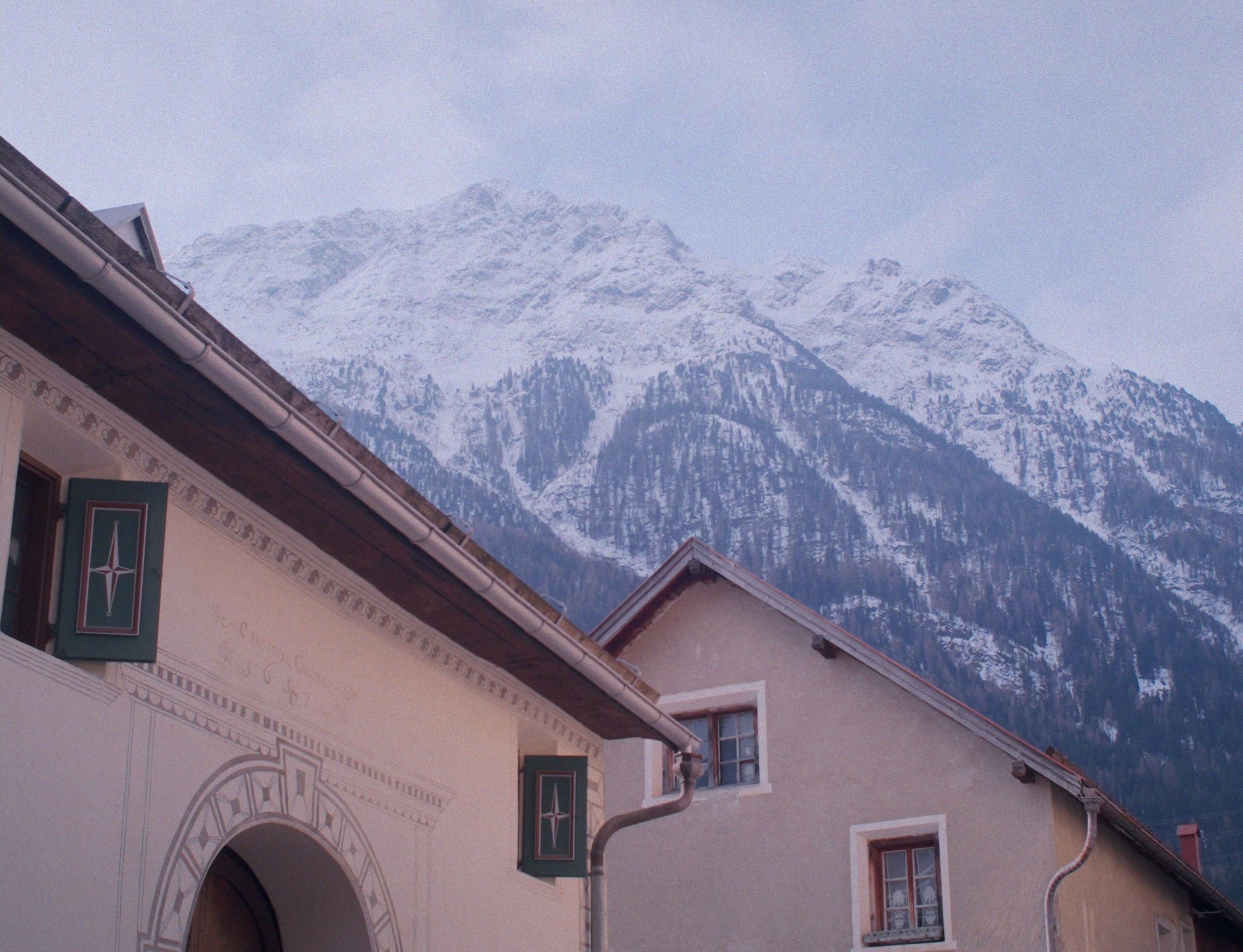
A frame from a recent film project, Ausländer.
People were present, thus leaving presents behind as a inevitability